

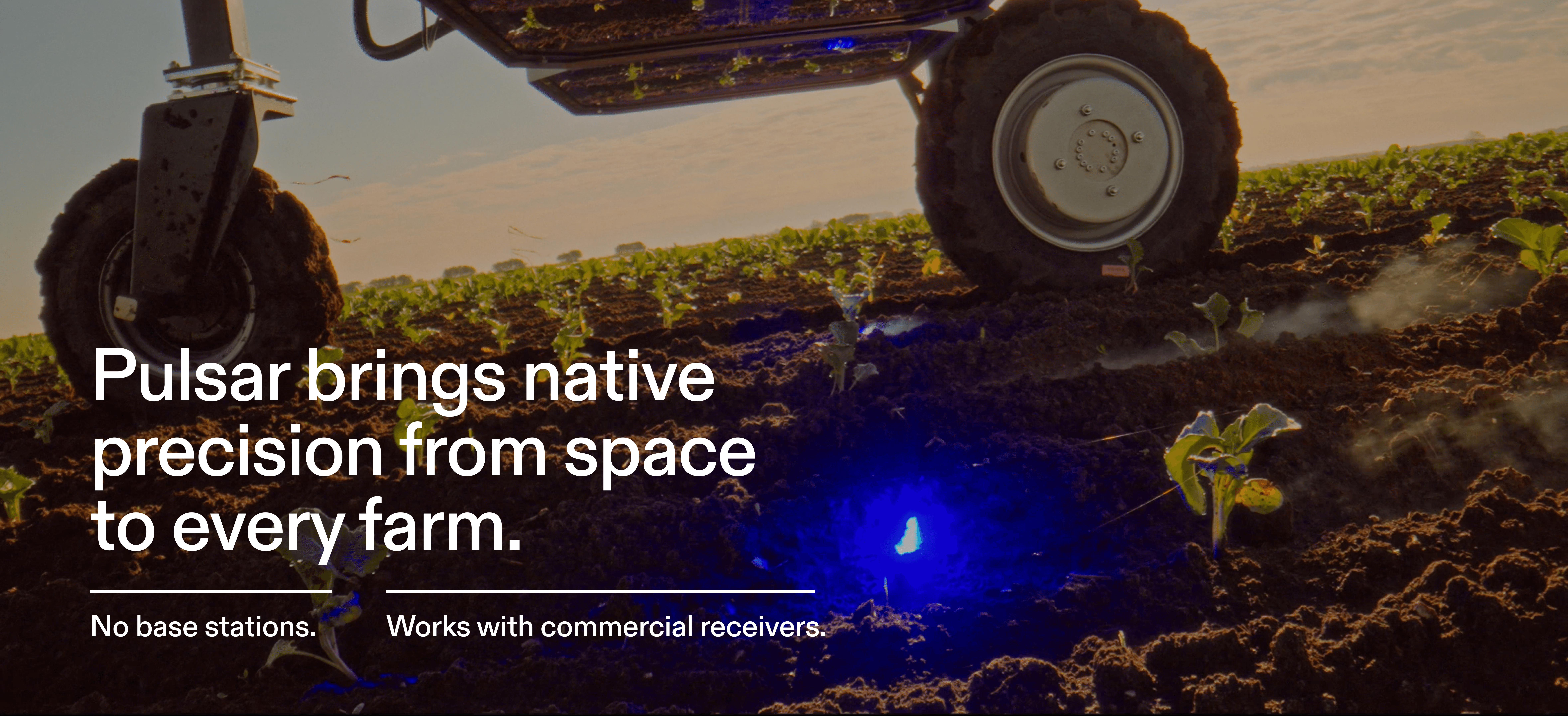
Earth Rover uses concentrated light to kill weeds without pesticides and map every plant’s health along the way. With Pulsar, Earth Rover will use satellite navigation with native precision to scale this capability to farms around the world, without complex local setups.
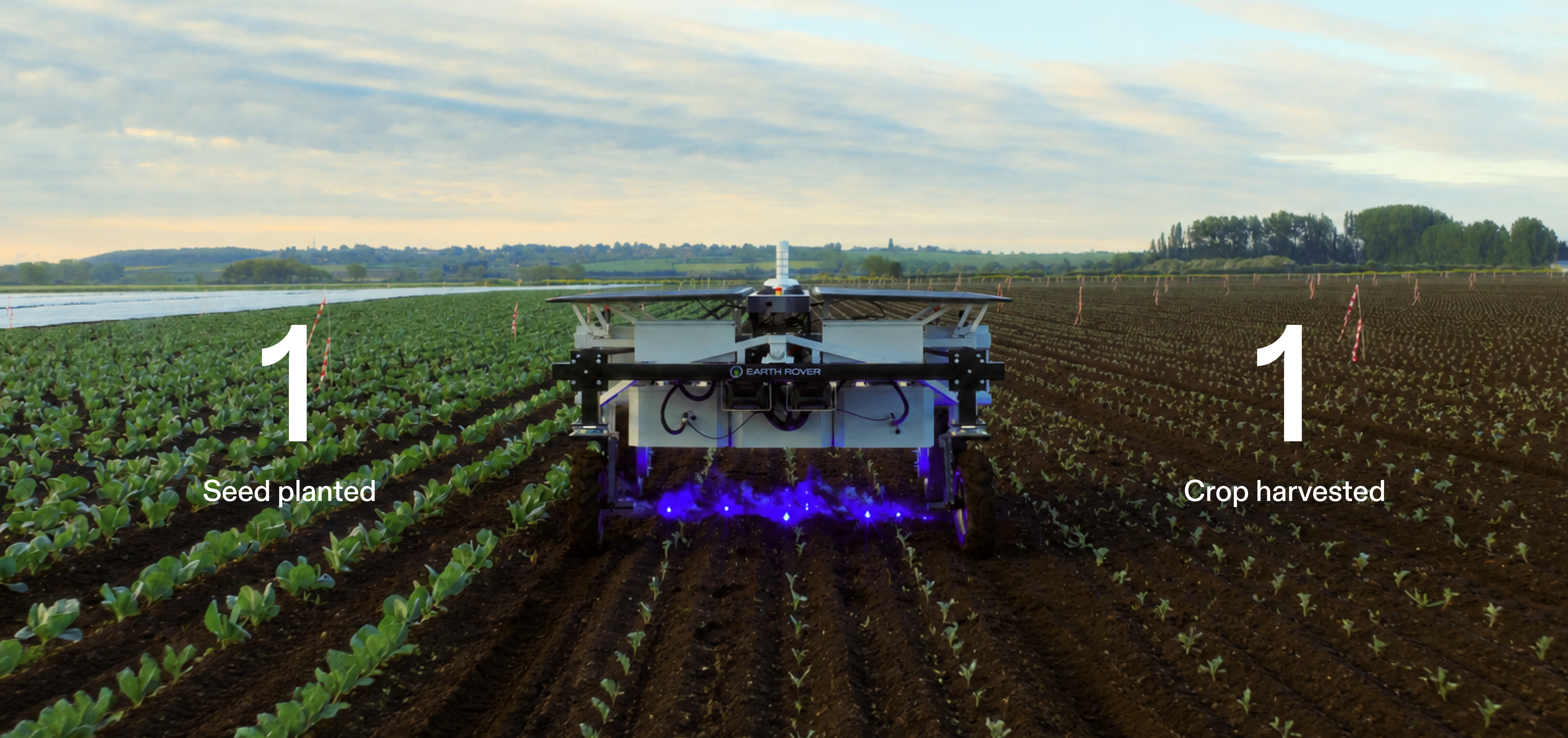
Enabling sustainability and plant-level farming: Earth Rover’s CLAWS robot maps every plant and targets individual weeds with concentrated light.
Precision without the setup burden: Xona offers a path toward high-precision satellite navigation without complex local base-station infrastructure.
Built to scale across farms: Small, lightweight robots can support one farm or many, helping make precision agriculture accessible to more growers.
Validated in a working greenhouse: Initial testing confirmed that Pulsar could be received inside a multipath-heavy commercial glasshouse while maintaining greater signal margin than GPS.
At a glance
Earth Rover is building a new kind of machine on the farm: solar-powered, lightweight, autonomous, and designed to mitigate weeds without chemicals. For James Brown, a fifth-generation farmer and founder of Earth Rover, the goal is not technology for technology’s sake. It is a better way to farm, inspired by lived experiences observing the rise in chemicals across agriculture first-hand. With CLAWS, farmers of every size and scale can protect their soil, reduce chemical dependence, and make sustainable food production more accessible for their community.
But scaling that vision requires more than autonomy. A robot that targets weeds at millimeter precision needs to know exactly where it is, even on farms with limited connectivity and without complex local setup. For James, bringing CLAWS to farmers everywhere requires a new layer of navigation infrastructure that keeps pace with their speed of innovation.
Initial testing has already begun. At a customer farm in the United Kingdom, Xona and Earth Rover successfully received Pulsar inside a working commercial greenhouse, an environment where glass, steel, and repeated structures create significant signal reflections. The test completed the first phase of the companies’ joint validation program and established a foundation for corrections and dynamic rover testing.
Precision anywhere, without complexity
Precision location in agriculture exists today, but for many farmers it can still be difficult to access, deploy, and maintain – requiring base stations, reliable connectivity, site-specific configurations, and equipment expertise. That can work for large, well-resourced operations, but it adds friction for smaller farms and for robotics companies trying to deploy across many different fields, crops, and countries.
For Earth Rover, that friction matters. CLAWS is not simply driving across an open field. It is moving through high-value crops, identifying individual weeds, and targeting the meristem with concentrated light. To do that safely and reliably, the robot needs centimeter-level positioning while performing work measured in millimeters.
“Every farm around the world is different. We need a solution that helps us find where a robot is anywhere in the world,” said James. “What we’re really excited about with Xona is the opportunity to go to any farm, anywhere in the world, and get going without complex setups delaying our work.”
Early results are promising. In testing, Pulsar was successfully received inside a commercial glasshouse. The structure reduced the strength and increased the variation of both GPS and Pulsar signals, but Pulsar maintained higher overall carrier-to-noise density. In the most representative high-elevation portion of the pass, Pulsar X1 also showed lower signal variation than the comparable GPS measurement.
Xona’s contribution is to make that precision easier to access directly from space. With Pulsar, Earth Rover sees a path toward robots that can arrive at a farm, understand where they are, and get to work without every field requiring complex local navigation infrastructure.
Using commercial off-the-shelf hardware
For agricultural robotics to scale, high-precision navigation cannot require every machine to become a custom hardware project. It needs to fit into the systems farmers and robotics companies can actually deploy.
By broadcasting new signals alongside GNSS systems of today, Pulsar is designed to work through the existing ecosystem people trust today, giving partners a path to add next-generation positioning capability through compatible commercial off-the-shelf receivers rather than entirely new hardware architectures.
For James, that matters because the product vision depends on small, lightweight, solar-powered machines. Every added component affects cost, power, complexity, serviceability, and adoption. The easier precision becomes to embed, the easier it becomes to bring plant-level farming to more machines and more farms.
“When you’ve got small robots, it enables any size farmer to adopt this technology. You don’t have to be a big industrial-size farm to have the best technology in your field,” said James. “Rather than making our machines bigger and bigger, we’re at this fantastic opportunity to have small, lightweight, smart machines that know exactly they are, know what they can see, and get going autonomously with the flip of a switch”
Innovation for Every Farmer
For decades, agricultural progress has often meant larger machines, heavier equipment, and more specialized systems. That model can improve efficiency, but it can also concentrate access among the farms with the most capital, infrastructure, and technical support.
Earth Rover points to a different future: small, lightweight, smart machines that can scale with the farm. A large grower might run a fleet. A smaller farm might start with one robot. In both cases, the promise is the same: precision tools that help farmers reduce chemical dependence, protect soil, and produce healthy food more sustainably.
Xona helps support that shift by making the navigation layer simpler, more accessible, and easier to deploy globally. The goal is not just better accuracy for the most advanced operators. It is precision that can travel across farms, across regions, and across the world.
